


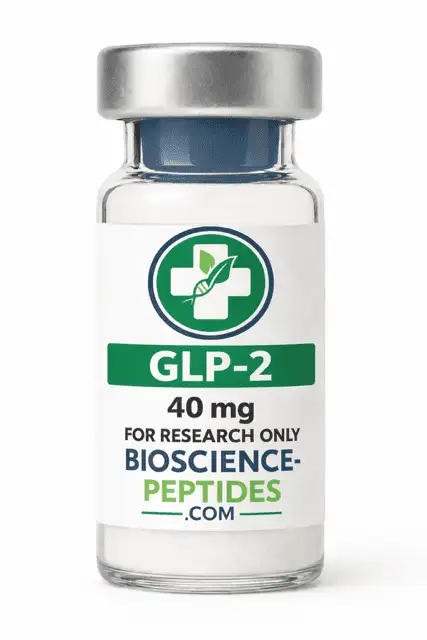
GLP-2 (40MG)
$210.00
GLP-2 (40 mg) is a research product named after glucagon-like peptide-2, a naturally occurring 33-amino-acid hormone involved in intestinal signaling and gastrointestinal function. GLP-2 is studied for its interaction with intestinal GLP-2 receptors and its role in research involving intestinal growth, mucosal integrity, and nutrient absorption. The exact identity and formulation of this 40 mg product should be verified through the manufacturer’s specifications. Intended strictly for laboratory research and educational purposes, not human or veterinary consumption.
GLP-2 (40 mg): Peptide Research and Scientific Overview
What Is GLP-2?
Glucagon-like peptide-2 (GLP-2) is a naturally occurring peptide hormone produced by specialized enteroendocrine L-cells in the intestine. It is released in response to nutrient intake and plays an important role in gastrointestinal signaling.
GLP-2 is a 33-amino-acid peptide derived from the larger proglucagon precursor. Scientific research has focused on its interaction with GLP-2 receptors and its relationship with intestinal structure, digestive function, and nutrient absorption.
The GLP-2 (40 mg) product listing identifies a research material by its stated quantity. Because native GLP-2 and modified GLP-2 analogues are not identical, the manufacturer’s documentation should be checked to confirm the exact compound supplied.
Understanding the GLP-2 Receptor
GLP-2 produces biological effects through the glucagon-like peptide-2 receptor, commonly abbreviated as GLP-2R. This receptor belongs to a family of G-protein-coupled receptors involved in cellular communication.
GLP-2 receptor activity has been investigated in several intestinal cell populations and supporting tissues. When the receptor is activated, it can influence local signaling molecules involved in intestinal function.
Researchers study these interactions to understand how gastrointestinal hormones communicate with intestinal tissues and contribute to normal digestive physiology.
GLP-2 and Intestinal Research
One of the most established areas of GLP-2 research involves intestinal growth and mucosal biology.
The intestinal mucosa is the specialized lining of the digestive tract. It contains structures responsible for nutrient absorption, including small projections known as villi and microscopic structures called crypts.
Research indicates that GLP-2 signaling is associated with intestinal mucosal maintenance and growth-related processes. Scientists investigate these mechanisms to better understand intestinal adaptation, epithelial cell activity, and gastrointestinal physiology.
These findings are important for understanding intestinal biology, but they should not be interpreted as proof that an unapproved research product can improve digestive health.
GLP-2 and Nutrient Absorption
The digestive system relies on coordinated processes to absorb nutrients and maintain fluid balance. GLP-2 has been studied for its relationship with intestinal blood flow, digestive activity, and nutrient transport.
Research involving GLP-2 signaling helps scientists investigate how the intestine responds to food intake and how hormonal pathways influence gastrointestinal function.
These mechanisms are particularly relevant to scientific investigations involving short bowel syndrome and intestinal adaptation.
Native GLP-2 and Teduglutide: What Is the Difference?
An important distinction in GLP-2 research is the difference between native GLP-2 and teduglutide.
Native GLP-2 is the naturally occurring 33-amino-acid hormone. Teduglutide is a modified GLP-2 analogue designed to resist enzymatic breakdown and remain active longer.
Teduglutide is the active ingredient in GATTEX, an approved prescription medicine in the United States for certain adults and children with short bowel syndrome who require parenteral support. This approval applies to the regulated prescription formulation, not automatically to products marketed as GLP-2 or supplied for laboratory research.
Researchers should not assume that a GLP-2-labelled product contains teduglutide unless the manufacturer confirms its identity. <Link url=”https://dailymed.nlm.nih.gov/dailymed/drugInfo.cfm?setid=66b69c1e-b25c-44d3-b5ff-1c1de9a516fa” title=”View the official GATTEX prescribing information”/>.
GLP-2 (40 mg) Product Information
GLP-2 (40 mg) is presented as a research-oriented product for scientific investigation. The 40 mg designation represents the stated quantity and does not establish a recommended dose, clinical application, or equivalence to an approved medicine.
Before evaluating the material, qualified researchers should review the supplier’s documentation, including:
- Confirmed compound identity and amino-acid sequence.
- Purity and analytical testing information.
- Batch number and manufacturing details.
- Certificate of Analysis (COA), where available.
- Product formulation and storage specifications.
These details help distinguish native GLP-2 from modified analogues and other similarly marketed compounds.
Research Use and Safety Disclaimer
GLP-2 research products should not be confused with approved prescription medicines. Modified analogues such as teduglutide have specific clinical indications and safety-monitoring requirements.
GLP-2 (40 mg) is intended strictly for laboratory research and educational purposes. It is not intended for human or veterinary consumption, injection, self-experimentation, diagnosis, prevention, or treatment of any medical condition.
Conclusion
GLP-2 is an important gastrointestinal peptide hormone studied for its relationship with intestinal signaling, mucosal biology, and nutrient absorption. Its receptor activity makes it relevant to research involving digestive physiology and intestinal adaptation. The GLP-2 (40 mg) product listing provides a research reference, while confirmation of the exact compound, formulation, and quality specifications remains essential.
Be the first to review “GLP-2 (40MG)”
Related products

FEATURE PEPTIDES
FEATURE PEPTIDES
FEATURE PEPTIDES
FEATURE PEPTIDES

CUSTOM ORDER
FEATURE PEPTIDES

FEATURE PEPTIDES
FEATURE PEPTIDES
Reviews
There are no reviews yet.