
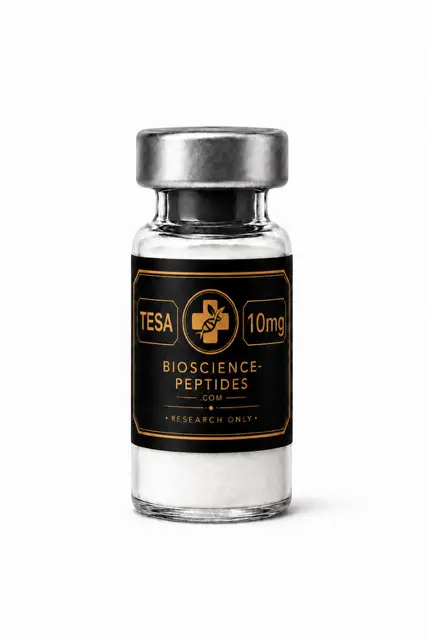
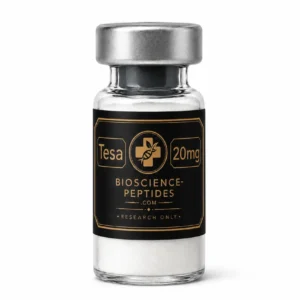
TESA (10MG)
$60.00
TESA (10MG) is a peptide research product commonly associated with tesamorelin, a synthetic analogue of growth hormone-releasing hormone (GHRH). Tesamorelin is studied for its interaction with pituitary growth hormone signaling and its role in endocrine physiology. This 10 mg product overview explores the compound’s molecular structure, receptor activity, scientific research background, and important product quality considerations. Exact identity and specifications should be confirmed through manufacturer documentation.
TESA (10MG): Tesamorelin Peptide Research and Scientific Overview
TESA (10MG) is a product listing commonly associated with tesamorelin, a synthetic peptide analogue of growth hormone-releasing hormone (GHRH). Tesamorelin has attracted scientific interest because of its interaction with the body’s endocrine signaling pathways, particularly those associated with growth hormone secretion. Its molecular structure and receptor activity make it an important subject in peptide research and endocrinology.
Understanding the properties of tesamorelin, its scientific background, and its product specifications provides useful information for evaluating this peptide-related product.
What Is Tesamorelin?
Tesamorelin is a synthetic analogue of human growth hormone-releasing hormone. It is based on the 44-amino-acid sequence of human GHRH and includes a structural modification designed to influence its stability.
Tesamorelin interacts with GHRH receptors located on specialized cells in the pituitary gland. These receptors participate in the regulation of growth hormone secretion.
Tesamorelin is distinct from other peptides such as sermorelin, ipamorelin, and CJC-1295. Although these compounds are associated with growth hormone research, they differ in their structures and mechanisms of action.
Understanding the Growth Hormone Signaling Pathway
Growth hormone signaling is regulated through interactions between the hypothalamus, pituitary gland, and peripheral tissues.
GHRH is naturally produced in the hypothalamus and signals the pituitary gland to release growth hormone. Tesamorelin is investigated because it interacts with this receptor-mediated signaling pathway.
Growth hormone is also associated with downstream pathways involving insulin-like growth factor 1 (IGF-1).
Research involving this signaling system includes:
- Pituitary hormone regulation
- Growth hormone secretion mechanisms
- GHRH receptor activity
- IGF-1 signaling pathways
- Endocrine feedback regulation
- Peptide-receptor interactions
These areas help researchers understand the complex mechanisms involved in hormonal regulation.
Tesamorelin and Scientific Research
Tesamorelin has been investigated in clinical and scientific research involving growth hormone signaling and body composition.
A prescription formulation of tesamorelin has been approved in the United States for a specific medical indication: reducing excess abdominal fat in adults with HIV-associated lipodystrophy.
This approval is specific to the approved pharmaceutical formulation and indication. It does not establish that every product sold under the name TESA or tesamorelin has equivalent composition, quality, safety, or clinical effectiveness.
Tesamorelin is not approved as a general weight-loss medication. Scientific findings should be interpreted within the context of the particular formulation and research setting.
Understanding TESA (10MG) Product Specifications
The 10 mg designation refers to the stated quantity of material in a product listing. It does not independently establish peptide purity, identity, potency, or suitability for a particular application.
When evaluating a tesamorelin-related product, important documentation may include:
Compound Identity: Confirmation that the product contains tesamorelin rather than another GHRH-related compound.
Purity Specifications: Available analytical testing and stated purity information.
Peptide Documentation: Manufacturer-provided information about the compound’s molecular identity.
Batch Traceability: Batch numbers and corresponding certificates of analysis.
Storage Information: Documented storage and handling requirements provided by the supplier.
Transparent product documentation helps establish material identity and supports accurate product evaluation.
Tesamorelin Compared With Other Peptides
Tesamorelin is sometimes compared with sermorelin and CJC-1295 because these compounds are associated with growth hormone research. However, their structures, pharmacological characteristics, and receptor interactions differ.
Ipamorelin acts through a different receptor pathway from tesamorelin. Therefore, these compounds should not be treated as interchangeable.
Understanding their differences is important when reviewing peptide research and product specifications.
Why Tesamorelin Remains Relevant in Peptide Research
Tesamorelin is an important subject in endocrine research because it provides insight into GHRH receptor activity and growth hormone signaling. Its scientific background has contributed to investigations involving hormonal regulation and peptide-receptor interactions.
Accurate compound identification and reliable documentation remain essential when evaluating tesamorelin-related products.
Final Overview of TESA (10MG)
TESA (10MG) is a product listing associated with tesamorelin, a synthetic GHRH analogue studied for its interaction with growth hormone signaling pathways.
When evaluating this product, confirm its exact identity, specifications, purity documentation, and regulatory status. A product label alone does not establish equivalence to an approved pharmaceutical formulation.
Important Disclaimer: This article is for educational and informational purposes only. Tesamorelin is a prescription medication for a specific medical indication. This product listing should not be considered equivalent to an approved pharmaceutical formulation. It is not intended for human or veterinary consumption, injection, diagnosis, prevention, or treatment of any medical condition. Consult a qualified healthcare professional regarding prescription medications.
Be the first to review “TESA (10MG)”
Related products
FEATURE PEPTIDES
FEATURE PEPTIDES

FEATURE PEPTIDES
FEATURE PEPTIDES
FEATURE PEPTIDES
FEATURE PEPTIDES
CUSTOM ORDER
FEATURE PEPTIDES
Reviews
There are no reviews yet.